
Sirk TV Comic Review: STAR TREK - DISCOVERY - OMNIBUS [IDW]
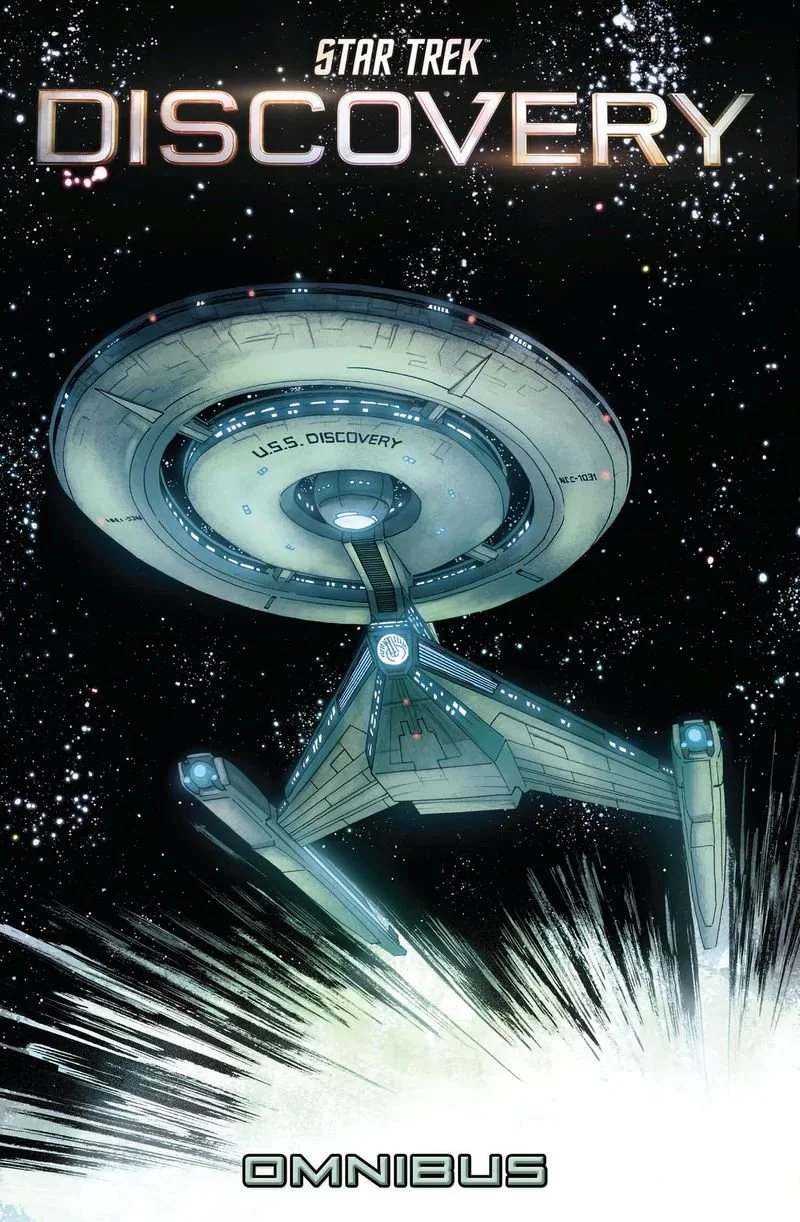
With "Star Trek: Discovery - Omnibus" [SC/440pgs/IDW], the story reflects how certain stories came to be. With the first tome: "The Light Of Kahless" the story follows Vox just before the initial engagement with the Federation at the beginning of Discovery's first season discussing the path of Kahless and his implementation of the new era. T'Jala is a young man who is the lowest of the ladder in his house which is slowly faltering. They do have a generational ship which boasts an interesting piece of technology. T'Jala is said to have visions of Kahless but he sees only a light. However, this is enough to get the local clerics going. Thus, he is called back to his home where his sister, acting as the head of the household has succumbed to a marriage proposal thinking that this is the only way to save her family. She however has become corrupted too since her would be husband just looks to increase his own greed. T'Jala returns before this betrothal and is cast out but asks that as penance, his sister leave him the generation ship even as she takes his house name with her. T'Jala brings the peasant people under his house and takes off in the ship spending the next couple years freeing people under greedy houses on certain planets. The light, he believes though, still evades him. He returns with his followers to Chronos after he finds a Federation listening drone on the edge of the Empire. The High Council thinks him egotistical and yet he is uniting the empire in a different way, which would ultimately become undone anyway. The light in many ways becomes a metaphorical thing that T'Jala encompasses. It is just a matter if Vox makes the same mistake. The tale is meant to back up the canon of the beginning of Discovery first season with a context of the mythology that motivates the Klingons as they are first encountered again. What is interesting is how much the generational ship in ruins does like the original derelict ship in "Alien".
The second story entitled "Succession" takes place in the mirror universe after Georgiou left. Like feudal elements and the Romans among others, the reign of power is only reflected by those who think they have the answers. In the mirror universe it always seems like other shoe is dropping. Nevertheless when the Emperor is gone and Burnham (in her other form) seems to disappear, a man-child named Alexander takes control and tries to implement a racial cleansing with a toxin aimed towards the Klingon home world. The twist in this involves a character both logical and vicious who really isn't optimized enough in the regular universe. Everyone's backs cannot be turned in the slightest or there is bound to be a double-cross. The twists of this story are particularly good and the thematics definitely play more adult, especially during a scene in a throne room although one action was definitely not forseen...and not the one you think. Ultimately this specific story pays more like "Game Of Thrones" where no one really wins.
The third story "Annual" follows Lt. Stamets before the beginning of the first season of "Discovery". This story, again written by Kristen Beyer, like the previous two focuses on strengthening the lore behind "Discovery". As is often the problem with film, TV and comic crossover, it is sometimes difficult to get everyone on the same page. Here it is revealed that Stamets was an independent scientist working with a partner before his doctor paramour ever came along. This story also shows the inception of that as well. The key with the spore was he finds a variant called Stella, which in reflection is just as destructive or powerful as Omega but in a different way. The interesting element is using it for transporter extension and control which was spoken of on "Enterprise" but not using this network. Ultimately the wills of two men and how they function are what is central. Starfleet is pursuing them. The other scientist is keyed in with his wife to a terraforming project. This pushes them apart. It is actually a good story which would have added to the lore of the television show but wasn't brought into play. But as always, it is about the restriction of time in television storytelling. Again, like the first story, it is an antecedent into the beginning of Discovery's season one which, as continually shown, does add more context across the board. The last short story before a couple differentiating pieces of cover art involves Linus, the Saurian and his search to find why the 4th of his four hearts had not begun beating in sync. This story takes place after Burnham becomes Captain but involves problem solving in the best way. It doesn't add anything overall to the canon but these short bits from the 32nd Century are just meant to enhance the world itself with this story does.
"Aftermath" does an interesting jump seeing Spock after Burnham was lost. These kind of bridge stories are very key to this kind of omnibus because it helps it function very well as a companion piece to the series. This keys slightly to the "Strange New Worlds" crew by optimizing Captain Pike while still bringing to bear Chancellor L'Rell while still dealing from the fallout with Discovery. This is more about how Spock is dealing with the absence of Burnham internally which he can never speak about openly which makes for an interesting internal monologue. We see him briefly on Vulcan with his mother and a walk he and Captain Pike take while he still had his beard. This would have been great to see on screen. The key here is peace talks with the Klingons and their changing variants which has always been an interesting link to walk. A water rescue sequence with Spock is neat visually but also character-wise in how it keys in what he needs to do to get back to his full self. It is a little truncated in terms of the storytelling but it still does get the job done.
"Captain Saru" as a story operates more in a standalone functionality because it shows a mode operandi of command before it was likely possible. If anything it shows that Saru was more ready than anyone expected to take command but other trials and time-frames still needed to be explored. Here the progression happens during shore leave when the distribution of power were still in flux. Burnham is still gaining the confidence of others but Saru is also coming to terms with his identity. Tilly had used her shore leave to do some work on a science vessel but one that has been trapped in a nebula. The antagonists are ones that are known but the way Saru deals with them is unique. However, the way they are accomplished is not fullly clear in the context of the story. The backtrace is the most important part of the narrative but it seems anticlimactic. That said, it shows Saru's growing command presence although the story does make reference to a novel that is not within this curriculum so some of its deeper meanings are less obvious to this reviewer.
"Adventures In the 32nd Century" are more some little standalone vignettes. The first one follows Grudge, Cleveland's cat, of which he always speaks has unnatural abilities. But this story takes place inside her head as she thwarts an intruder who tries to steal her and Cleveland's small ship. The best part though is how she sees Discovery with her snarky humor, just as one would think she would. The second mini story involves Adira and how they came to be especially with Gray. Their relationship, though unconventional is much clearer here than in other progressions. Adira's existence aboard a generational ship speaks more to their interests and Gray's humor is just as obvious but the interrelation of the symbiote is more pronounced though the joining is still a little fuzzy. This short story is just meant to add pinch of color to the proceedings. The next short story follows Discovery's pilot Kayla who, as we saw in a later season, had some problems with her implants. This story reflects more in a Saurian psychology since she reverts to something in her tween years that cemented her personality and her love of Starfleet. While the story is a little more metaphysical, that is something that comics can do that television sometimes can't or doesn't have the time to do. Its effects can also last way beyond where the story ends.
The "Star Trek": Discovery - Omnibus" works in that it adds necessary context, specifically in the mirror universe that really give a sense of progress in a episode build on tv that tends to get smaller and smaller. It is also is very telling in Spock's internalization at one point as well as in the Kahless story. All these help diversify the superstructure that formed the show. B
By Tim Wassberg